English
 Arabic
I’ll get it clear right out of the gate: I think the AMD 3D V-Cache chips are absolutely the best choice for a PC gamer wanting to get the absolute most out of their system when it comes purely to silky gaming frame rates. They’re great CPUs, which use a hefty dollop of extra L3 cache specifically to improve their gaming performance, and that’s why the Ryzen 7 9800X3D still sits proudly at the top of our best CPU for gaming list.
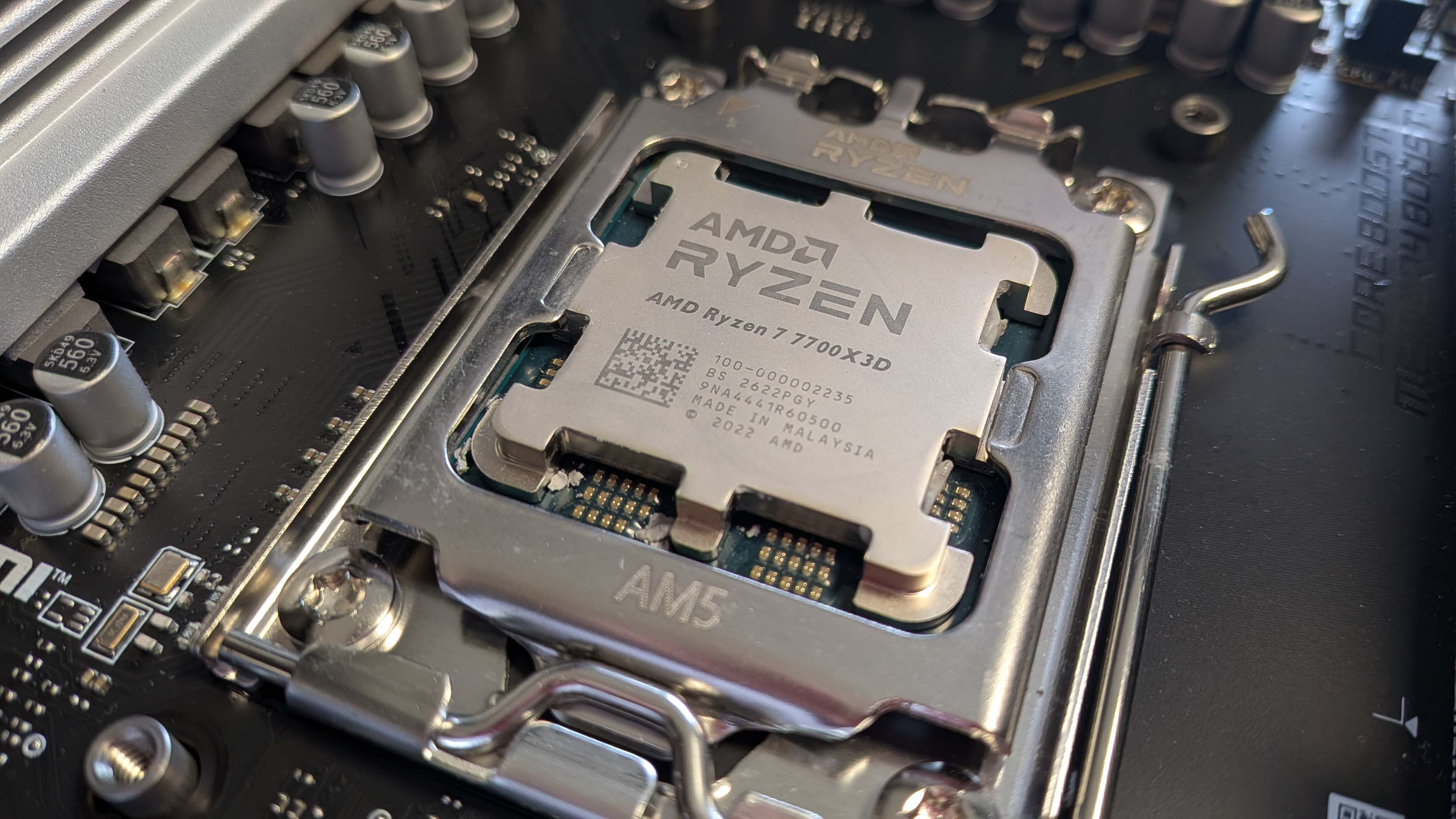
But, having just finished writing up my AMD Ryzen 7 7700X3D review, AMD’s latest pitch for a budget gaming chip, it’s made me seriously consider whether I would actually pick Intel’s Core Ultra 5 250K Plus instead. And I rather think I might.
The whole justification for the existence of the 7700X3D—a chip that is essentially just a slower clocked Ryzen 7 7800X3D, itself a great CPU from 2023—is that AMD is delivering a more affordable 3D V-Cache CPU to drop into your existing AM5 motherboard. That is, on the surface, a laudable endeavour.
There are a couple of problems here, however. The first is competition from within the AMD stables; namely the fact that, while the 7700X3D does have a vastly lower MSRP to that of the 7800X3D (it’s $329 plays $450) the older chip has had a long time to establish itself in retail and as such there are a lot of them around. And that means the actual on-sale prices are essentially the same, and sometimes the 7800X3D is actually available for less than the 7700X3D.
And the second issue is that the value proposition of the 7700X3D only really stands up if you are looking to make a CPU upgrade to an existing AM5 system. Say, if you’ve already got a rig with a Ryzen 5 7600 in it, for example. But if you’re building a new system from scratch—and if you are, I feel your pricing pain, my droog—then at this end of the market the latest Intel Arrow Lake chips are mighty tempting.
The Intel Core Ultra 5 250K Plus has popped up with low-end pricing and high-end performance. It may only come rocking a six Performance-core layout, with 12 Efficient-cores, but that does give it 18 cores of multi-threaded grunt and some surprisingly good gaming prowess to boot.
1080p gaming performance
We test games at 1080p for CPU tests to better highlight performance diffences between chips
Avg FPS
1% Low FPS
| Product | Value |
|---|---|
| AMD Ryzen 7 7700X3D | 112 Avg FPS, 73 1% Low FPS |
| Intel Core Ultra 5 250K Plus | 118 Avg FPS, 93 1% Low FPS |
| AMD Ryzen 7 7800X3D | 120 Avg FPS, 88 1% Low FPS |
| AMD Ryzen 5 7600X3D | 117 Avg FPS, 59 1% Low FPS |

Sure, it’s not quite got the 3D V-Cache boost, but in a lot of games the Intel chip is really not far off the pace of either the 7700X3D or the 7800X3D. And it comes with a price tag of just $200. Even AMD’s budget six-core X3D chip, the Ryzen 5 7600X3D is more expensive than that.
Intel’s chip will give you a far more rounded processor, with plenty of gaming and a ton of productivity performance for $130 less than the latest X3D budget option. That gives you $130 dollars to spend on a better GPU than you might have otherwise been able to afford if you’d built around the AMD platform. And just look at the relative compute power on offer with this thing versus the more expensive AMD chips.
Compute performance
We may be PC Gamer but we also want to know what the productivity capabilities are of our CPUs
Single-core index score
Multi-core index score
| Product | Value |
|---|---|
| AMD Ryzen 7 7700X3D | 102 Single-core index score, 1011 Multi-core index score |
| Intel Core Ultra 5 250K Plus | 138 Single-core index score, 1817 Multi-core index score |
| AMD Ryzen 7 7800X3D | 113 Single-core index score, 1082 Multi-core index score |
| AMD Ryzen 5 7600X3D | 107 Single-core index score, 810 Multi-core index score |
The caveat to the Intel positivity here, though, is the platform longevity of AMD’s AM5 socket is absolutely unrivalled in the industry. While AMD has confirmed that it will be supporting the socket through to 2029, and has recently celebrated the 10 year lifespan (and counting) of its AM4 platform, Intel is still replacing its CPU socket pretty much every generation.
So yes, that means the board you stick the Core Ultra 5 250K Plus into only has a very limited upgrade path within the Arrow Lake generation, and any new Intel chips you covet will require an entire motherboard upgrade, too. That means, if you are the sort of person who is going to look at a CPU upgrade down the line, the dead-end of the Intel LGA 1851 socket is going to be a barrier to your future-proofing plans.
But it’s worth asking yourself whether that really is going to be you. Be honest. When was the last time you actually did an in-place CPU upgrade? The notion of future-proofing your build with an easy upgrade path is always a tempting one, and is a good way to extend the operating life of your rig, especially in these ‘spensive times of ours.
But if you’re one of the majority of PC gamers who never touches that part of your machine, who might only ever upgrade their GPU or SSD at a push, then maybe it’s worth considering making the savings up front and putting that towards a better graphics card in your build.